

👋 This post continues a series of interviews with authors. You can read the most recent, an interview with Seth Insua, here. Brendan Mac Evilly is a writer, curator, photographer, and founder of Holy Show, an arts journal and production company. He is the author of Deep Burn (2025, Marrowbone) and At Swim: A Book About the Sea (2016, Collins Press). His work can be found in Winter Papers, The Stinging Fly, and many other publications.
Deep Burn follows Martha Knox in the wake of the dissolution of her brief marriage as she impulsively takes up residence at an artist’s studio in a rural town in Kerry. Supported by Vinny, a charismatic Virgil to guide her through the circles of the art world, she establishes herself as a photographer. Her project: burning objects of sentimental or personal value and capturing the process in images. It is a taut artist’s journey viciously powered by the question of what is real — and what is not — in an industry supposedly predicated upon genuine expression. It is available at most booksellers, including Books Upstairs.
Our interview was, as always, conducted over e-mail and then edited for flow.
Humans can’t exist without the sun. For most of history, we’ve worshipped it. Fire is like your own personal sun. It always looks roughly the same, and yet is never the same twice…
Brendan,
One of the aspects that captivated me most when reading Deep Burn was and continues to be Martha’s photography project. The objects she burns are of immense psychic weight, you do great work on the page for the reader to feel how heavily they have weighed on their carriers. When something so emotionally concrete is destroyed it ceases to exist and so, these people hope, does the baggage it carries. These objects go away. To then immortalize the exact moment of their destruction in a photograph is a reversal: the object lives on but only as an image, unburdened by its sentimental value, or else with that value transformed into something cathartic.
I know through our friendship (and an upcoming performance at the Cúirt International Festival of Literature) that you were/are a bit of a firebug. I’m curious what you personally make of fire as a transformational force. What is it that entrances us to it? Is it a purification? A destruction? What does Martha see in the flames?
James
James,
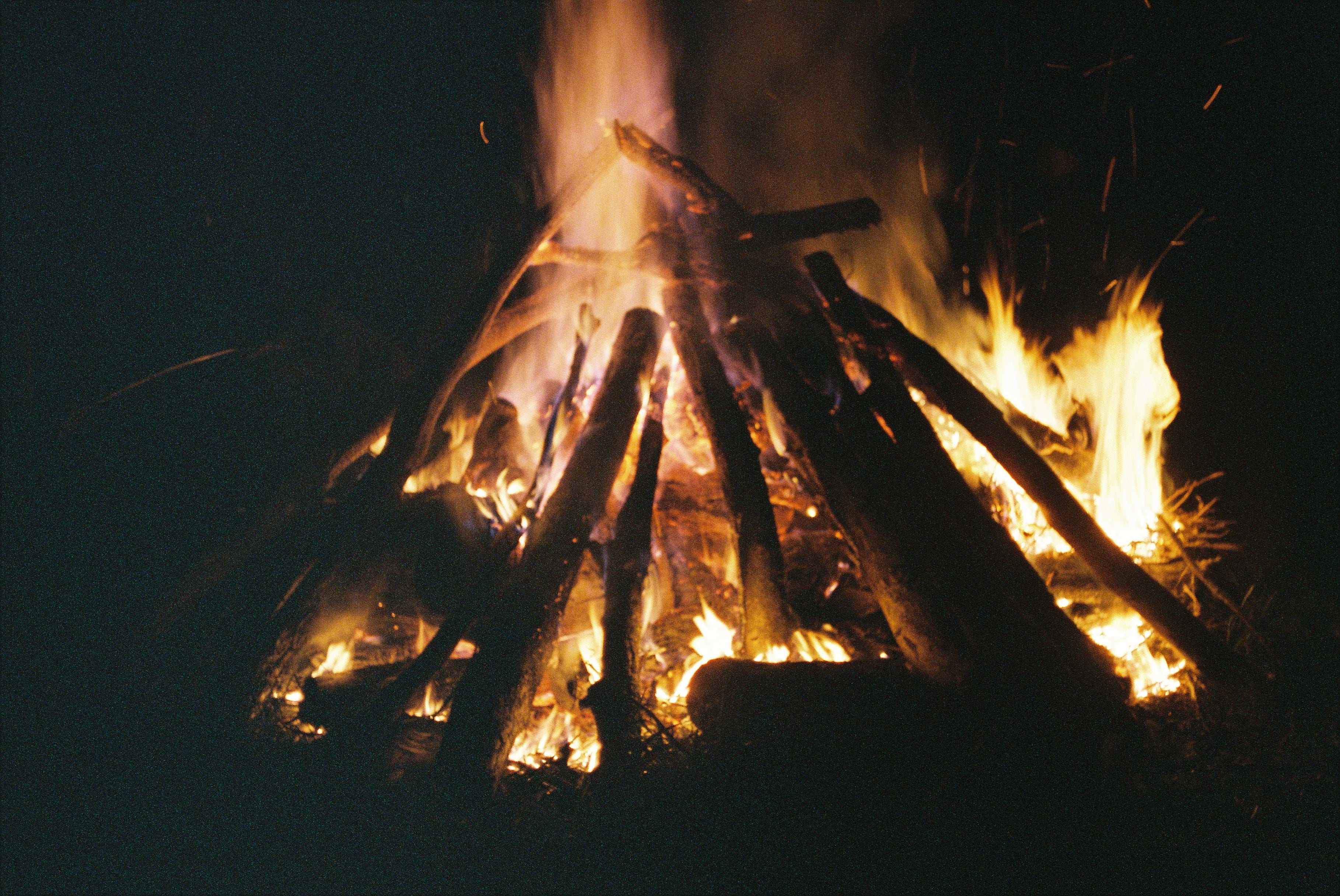
Fire has a hypnotic, transfixing quality. That’s its primary pull for me, and I guess for Martha. Humans can’t exist without the sun. For most of history, we’ve worshipped it. Fire is like your own personal sun. It always looks roughly the same, and yet is never the same twice, snowflake-esque in its uniqueness. It is an incredible pleasure on the eye. I think everyone can relate to this. And we all know the experience of being in a pub, say, and the stupid TV, even if its horse-racing or something equally dour, catching your eye. You have to make an effort to pull your eyes away. So there’s some primordial thing going on there, too, the mind’s need for sources of light. Mostly, though, it’s just beautiful, isn’t it?
When you start to make art with it, as Martha does, the viewer, and the reader, the curator, the gallerist, whoever, is implicitly asked (or asks themselves) what does it mean? Destruction, metamorphosis, rebirth. You can make fire do all kinds of metaphorical leaps and jumps. This is what makes Martha nervous. She wants to evade analysis of her work as much as possible, but knows it’s inevitable if she’s going to become an artist. Really, she and I are the same sort of person in that we just love fire, but in an art context, you’re forced to dig a bit deeper. That’s partly why she’d prefer to set up as a consultant or service provider as opposed to an artist. I think an artist working with fire, in the way that Martha does, exorcizing people’s bad juju, is a role more akin to a priest or wizard.
It’s only now that I’m writing ‘A Personal History of Pyromania’ (an upcoming live audiovisual essay for performance) that I’m really digging in to fire’s various meanings. There’s this farmhouse in Kerry, in Ballinskelligs, where I set the novel, and it’s kind of a bit run down, the land around it is poor, the car and tractor in the driveway are clapped out, but there is always smoke coming out of its chimney morning, noon and night. And there is always an enormous mountain of turf outside the house, right at the gateway, in full view of passersby. It occurred to me that fire in this context is sort of a status symbol. Is the permanently smoking chimney a kind of dying social signifier? Fire = heat. Fire = money. Fire, in an Irish context, in the context of turf cutting = land + labour.
In the novel it provides a source of destruction, purification, metamorphosis, rebirth. But that relies on the people who receive Martha’s service ‘having faith’ in her process. We’re back to religion again. Fire is great for that. Human sacrifices, lighting candles to remember the dead, etc. I went to a ‘Dawn Easter Mass’ once in another part of Kerry where the whole town goes to the local graveyard at 5am on Easter morning while it’s still dark and stands by the graves of their loved ones while the local priest delivers Mass over the PA. In the next field over is a huge skip filled with wooden pallets, a gang of lads pouring petrol on top. And at a certain point in the mass, the priest conducts a local widower who wields a burning sod of turf on a pitch fork to light the fire. “The almighty blaze will connect us with loved ones who have died and for whom we are here this morning”. Basically, he uses the fire for a bit of metaphorical resurrection. It’s mad. And brilliant.
In the end, I loved Martha and her work so much that I thought I’d try to become her. I got more into photography, and I’ve taken to burning fires in fireplaces of abandoned houses to bring about a sort of resurrection, too. Maybe just to think about the last time the fire was lit in those places, to reify their stories and histories. I’ve even burned and photographed an ‘emotionally significant’ object for a friend and photographed it, just like Martha does.
Last year I took up ceramics. I wanted to bring the world of the novel to life and make some of the significant objects that get burned. It seemed, in one way, like the opposite of what Martha was doing, because fire disappears things whereas making objects with clay brings them into being permanently. It occurred to me relatively late in the process that clay needs fire, it needs to be burned at over 1000° C. Fire becomes a source of memory again. Fire + clay = permanence.
Brendan
Brendan,
This is a novel about the artist's journey. Where some might venture towards some moralistic exceptional quality of the arts in the form of redemption, you chose instead to highlight someone searching for something real who, in the end, does not quite find it. The holy structure of the arts world turns out to be another farce of people making it up as they go along, but doing so convincingly, and to great personal profit. The only one seemingly left in the dark is sadly Vinny, whose artistic projects get more and more desperate for someone — anyone — to imbue him with validating purpose and anoint him an ‘artist,’ a task he eventually takes into his own hands.
You've spent considerable time in the arts as a writer, photographer, and a founder of Holy Show. It's safe to say that this world is one you know quite well. Do you find it as empty as Martha does?
James
James,
The novel takes art and its making out of the world we know — in Ireland say — and into the global art world, which really means to a place of capitalism on steroids. A place like this can be kind of alluring to an artist because someone else is going to do the work of hyping, selling, etc, and what you get in return, in theory, is lots of money, which for an artist means the ability to make and create the art they really want, forever. The great concern or worry for most artists is ‘how do I make this work’, or ‘how do I make art and also pay the bills.’ So if you can find someone to sell your work for wildly inflated prices, great! But this is a corner of the art world that most of us, back here in reality, will never really come into contact with at a personal level.
In the literary world, things are a bit more honest. A publisher produces a mass-produced object as cheaply as they can and sells as many units as they can for a tiny margin on each book. I also think humans are generally experts at telling and reading stories, so we can tell a good piece of literary art from a bad one pretty quickly, or at least we’re fairly confident about what we like and dislike. Art is a bit different. Many artists produce one-offs as opposed to something cheaply mass-producible. The gallerist then takes that singular object and pitches buyers a bamboozling story, often with bamboozling language, to inflate the importance and price of the artist and their work. Those kinds of stories (and sometimes that kind of art) are more difficult to read. The story a gallerist tells is less like a blurb or elevator pitch for a novel, and more like a business pitch for a new AI company. Maybe it will skyrocket, or more likely it will come to nothing.
I think that Vinny knows all this about the art world. He sees through it. And he helps Martha to use the farce to her advantage. But when she begins to succeed, far beyond his expectations, his ego kicks in. ‘The fat relentless ego’ as Iris Murdoch calls it. One part of his brain is telling him, ‘don’t worry, it’s all bullshit, just be happy for her’. But the other part is saying ‘Keep up!’ ‘Achieve greatness! Be somebody!’ Would it be true to say we can all relate to this? I can, certainly. I have a fat relentless ego that frequently wants a little more than it has. Sometimes a lot more. Even though I know I already have more than enough to be happy or content. Vinny ultimately falls victim to himself.
As for finding it empty, definitely not. I find it lush, rich, rewarding, full of interesting people, earnestly writing, devising, making great work, mostly at a modest scale i.e. not necessarily achieving international fame. Those writers and artists I know personally who have achieved international recognition deserve it. They’ve worked incredibly hard for it and also don’t really care about it. When I say ‘earnest,’ I guess I mean that the thing they care about most is the work itself, making it as good, original, interesting, thought provoking as possible. I set up Holy Show to showcase some of this, to whatever degree I could. There are so many good artists in Ireland at the moment across all forms. And the best work usually comes from the best people because people’s work usually reflects their personality... hilarious, deeply intelligent, deeply considerate. Artists who don’t take themselves too seriously, but do take their work seriously.
I guess for the novel, I dramatised the more cynical aspects of the art world. But the art world I know (let’s call it art land, or even arttown, instead of art world) is full of great work, and great people, and a handful of nutters and chancers.
Brendan
I first met Brendan years ago in the since-refurbished upstairs of Hodges Figgis for a book launch. Since then, we’ve become good friends and members of a writing group.
I had the pleasure of reading an early draft of Deep Burn and it was personally and artistically illuminating to read its final form and see how much it has — and hasn’t — changed.
You can find more information about Brendan, including his work and contact information, here.
-JSR